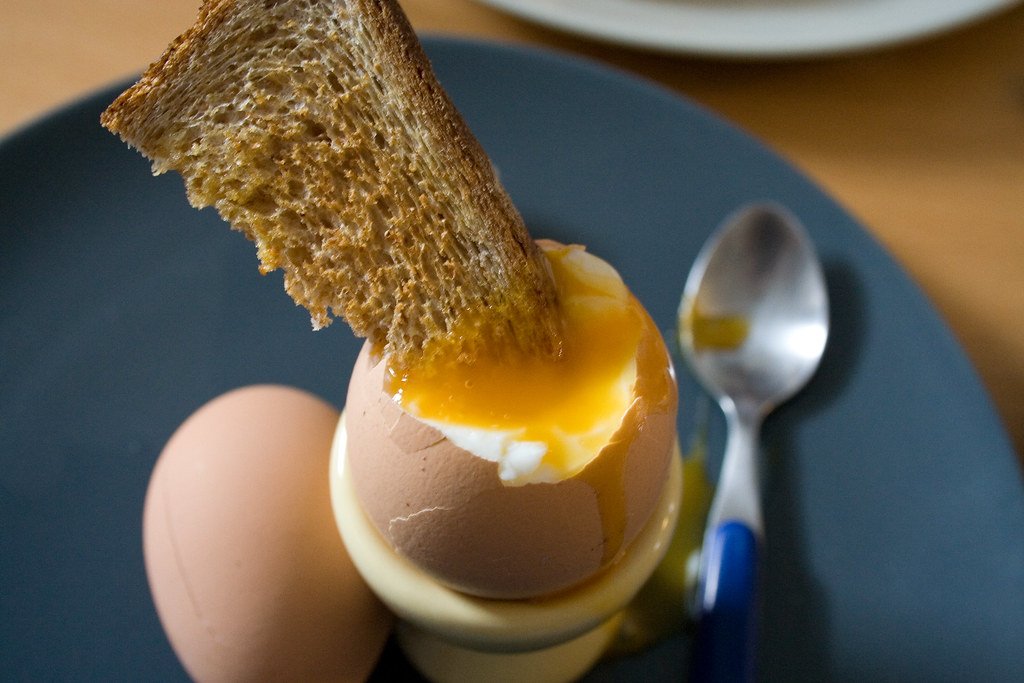
Photo: Christian Cable, CC BY 2.0, via Flickr
For most of us, egg and soldiers was the first proper breakfast we ever had. A soft boiled egg in its own little cup, the top taken off, and a row of buttery toast fingers lined up ready for dipping. It is a small child's idea of heaven, and plenty of us have never grown out of it.
The fingers of toast are the soldiers. You dip them in the yolk, one after another, and when the yolk has gone you scoop out the white with a teaspoon. That is the whole meal, and it needs nothing more than an egg, a slice of bread, some butter and a pinch of salt.
It is also, as anybody who has got it wrong will tell you, a meal where a minute makes all the difference.
Because they are straight and narrow and stand in a row, like soldiers on parade. It really is as simple as that.
People have been dipping bread into eggs for as long as there have been bread and eggs, and cutting toast into fingers is nothing new either. An English cookery book of 1728 talks about fried bread cut the length of one's finger. The French have dipped strips of bread into boiled eggs for generations and call them mouillettes.
What might surprise you is how young the English name seems to be. As far as anyone can tell, the phrase eggs with soldiers only really caught on in the 1960s. It may have been helped along by a set of television adverts for eggs in 1965, starring the comedian Tony Hancock. The first time anybody has found it in print is in a novel by Nicolas Freeling, The Dresden Green, published in 1966. We are quite sure children were eating their soldiers long before that. It just took the grown ups a while to write it down.
What you are after is a white that is completely set and a yolk that is hot, thick and runny. Here is how to get it.
Start with eggs at room temperature if you can. An egg straight out of the fridge is more likely to crack, and it takes longer. Bring a small pan of water to the boil and then turn it down to a steady simmer. Lower the eggs in on a spoon, gently, so they don't bang on the bottom.
For a large egg, give it five minutes. A medium egg wants about four and a half. If the eggs have come from the fridge, add about a minute. Then lift it out, pop it in its cup and take the top off straight away, because an egg carries on cooking inside its shell and a perfect yolk can turn solid while you are buttering the toast.
As for how you open it, there are two schools of thought. Some people tap all the way round with the edge of a teaspoon and lift off the cap. Others take the top off with one swift stroke of a knife. Families have fallen out over less. Add a pinch of salt and you are ready.
Put the toast on while the egg is boiling, so the two are ready at the same moment. White bread is traditional, from a proper loaf. Toast it until it is golden and firm, because a floppy soldier is no use to anybody.
Butter it generously while it is still hot. Cut the crusts off if you like, and cut the slice into strips about as wide as your finger. They need to be narrow enough to fit inside the egg, which sounds obvious until you have made them too wide.
Some people spread their soldiers with yeast extract, which gives you the saltiness without needing salt on the egg. When asparagus is in season, a few lightly cooked spears make very elegant soldiers indeed.
And if you are feeling indulgent, cut some fried bread into fingers. It is richer and crisper than toast, and it is probably closer to what that cook had in mind back in 1728.
The definitive reference book on the traditional English breakfast.
View the HandbookThe egg on a full English breakfast is usually fried. The boiled egg belongs to a different and older kind of breakfast, the quiet one of egg, toast and tea that you have on an ordinary morning when a whole fried plate would be too much. We love it for exactly that reason. It is simple, it is comforting, and it takes you straight back to being about five years old.
If you are interested in history, heritage and recipes of the traditional English breakfast, check out our official English Breakfast Handbook, lovingly produced by the English Breakfast Society.
This site is independently run. Reader funding helps keep standards high.