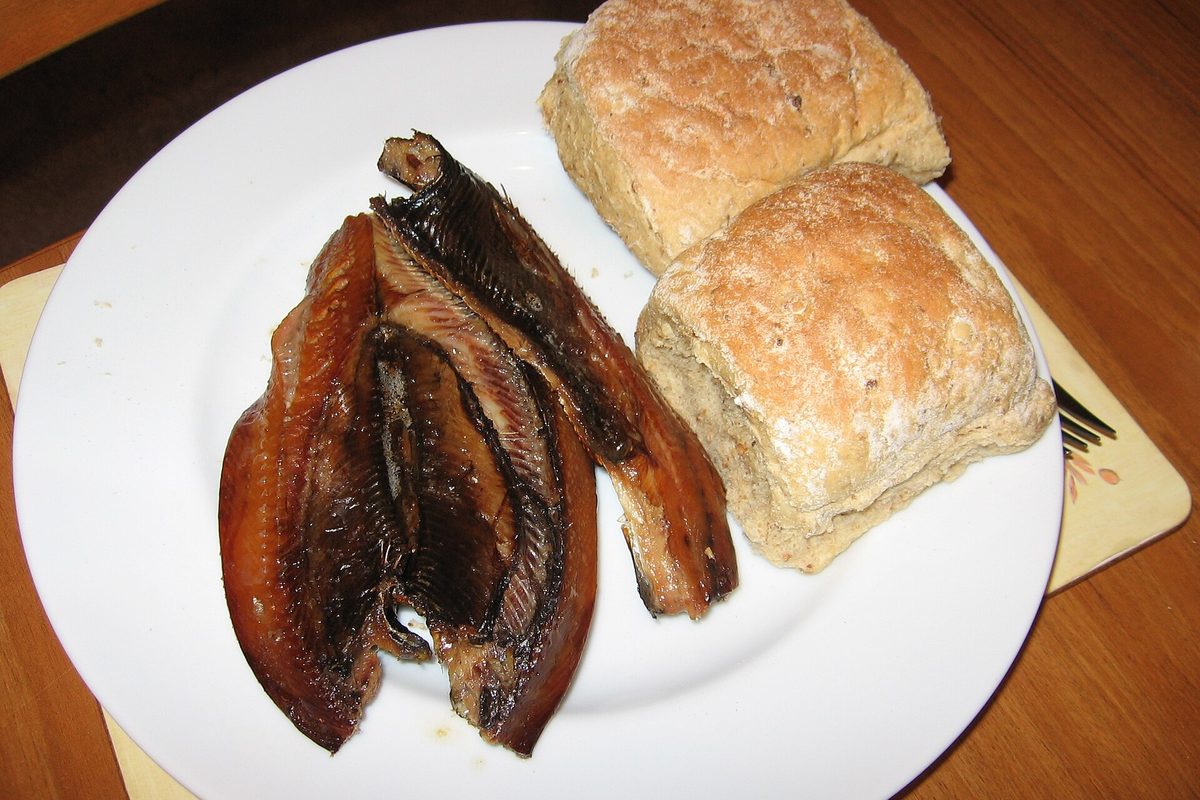
Photo: PookieFugglestein, CC0, via Wikimedia Commons
There was a time when half of Britain woke up to the smell of kippers. For a good hundred years they were as much a part of breakfast as bacon and eggs, in grand hotels and railway dining cars and ordinary kitchens alike. They have slipped off most menus since, which we think is a terrible shame, because a good kipper with brown bread and butter and a pot of tea is one of the finest breakfasts this country ever came up with.
So what is one? A kipper is a whole herring that has been split down the back from tail to head, opened out flat like a butterfly, gutted, salted, and smoked slowly over smouldering oak.
The details matter. A herring smoked whole, without being split, is a bloater. One that is hot smoked whole is a buckling. Only the split, cold smoked fish is a kipper. And because the smoke flavours the fish without actually cooking it, you cook a kipper before you eat it.
The word is older than the fish. To kipper something originally meant to split and smoke a salmon, and people were doing that long before anybody tried it with a herring.
The herring kipper as we know it is usually credited to a man called John Woodger, a fish curer at Seahouses on the Northumberland coast, in 1843. The story goes that some herring were left overnight in a shed where a stove was smoking, and in the morning somebody found they had turned into something wonderful. We have no idea whether it really happened that way, but it is a good story, and Woodger certainly made the most of it. He went on to produce kippers in huge numbers at North Shields and Great Yarmouth, and there are smokehouses on that site at Seahouses that have been working since that very year.
His timing was perfect. The railways were spreading across the country, and a lightly cured fish that would keep for a few days could be on a train at the coast in the evening and on a breakfast table in London or Birmingham the next morning. Within a generation the kipper was everywhere.
A handful of places still make kippers the way they should be made, and they are worth seeking out.
Craster, a tiny fishing village a few miles down the coast from Seahouses, has a smokehouse built in 1856 that the Robson family have run since they bought it in 1890. On the Isle of Man, the Manx kipper is cured at Peel, where Moore's kipper yard has been going since 1882. Mallaig and Loch Fyne on the west coast of Scotland, Stornoway in the Hebrides and Whitby in Yorkshire all have devoted followers too. If you ever get the chance to visit one of these places, go. The smell alone is worth the trip.
What the good makers have in common is that they don't dye their fish. A proper kipper gets its colour, a pale coppery gold, from long hours in the smoke and nothing else.
That deep mahogany kipper you see on a lot of fish counters is not what it seems. During the First World War, curers started dipping their herring in brown dye. A dyed fish needed far less time in the smokehouse, and since smoking dries a fish out and makes it lighter, less smoking meant more weight to sell. In the trade they called them painted ladies.
It became the normal way of doing things. The dye these days is annatto, a natural colouring, but the trick is the same. If a kipper is very dark and suspiciously even in colour, it has almost certainly been dyed. An undyed kipper is paler and tastes of smoke and herring, which is the whole point.
One other thing has changed. The North Sea herring fishery collapsed in the 1970s, and a lot of kippers are now made with herring from Norway or the Atlantic. That is nothing to worry about. It is the cure that makes a kipper great.
There are three good ways, and none of them takes more than a few minutes.
Our favourite is the old fashioned one, called jugging. Stand the kipper head down in a tall jug, or lay it in a deep dish, and pour boiling water over it. Leave it for six minutes, lift it out and drain it. That's it. The fish stays beautifully moist, and best of all, your kitchen doesn't smell of kippers for the rest of the day.
Grilling gives you a bit more flavour. Lay the kipper skin side down, put a knob of butter on top and grill it for about five minutes, until the butter is sizzling. You don't need to turn it.
Or you can fry it. Melt a little butter in a wide pan and give the kipper two minutes flesh side down, then three minutes skin side down.
The definitive reference book on the traditional English breakfast.
View the HandbookServe your kipper on a hot plate with a wedge of lemon and plenty of brown bread and butter. A poached egg on top is traditional and absolutely delicious.
We know what puts people off, and it is the bones. Here is the trick. Take hold of the backbone at the tail end and lift it gently, and it comes away in one piece, bringing most of the fine bones with it. The few that are left are soft enough to eat without noticing.
When George Orwell sat down in 1945 to list the glories of English cooking, kippers were the very first thing he wrote down. We think he had his priorities right. If you find a hotel that still has them on the breakfast menu, order them. And then tell the manager how pleased you are, so they keep them there.
If you are interested in history, heritage and recipes of the traditional English breakfast, check out our official English Breakfast Handbook, lovingly produced by the English Breakfast Society.
This site is independently run. Reader funding helps keep standards high.