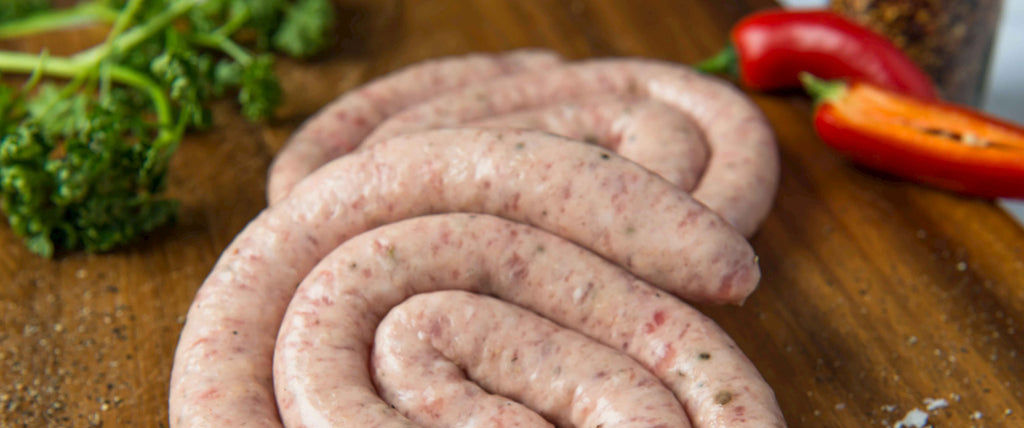
You can spot a Cumberland sausage from the other side of the butcher's shop. It is the one that hasn't been twisted into links. A proper Cumberland is made as one long, continuous sausage, sometimes half a metre or more, and wound round into a flat coil like a Catherine wheel. In Cumbria, butchers will still sell it to you by the length, cutting off as much as you fancy.
It is just as distinctive on the inside. The pork is chopped, not minced into a paste, so when you cut into one you can actually see the pieces of meat. There is a lot of that meat, and there is a lot of pepper. This is a big, bold, properly seasoned British sausage, and once you have had a real one, the smooth pink sausages from the supermarket taste of very little.
The sausage is named after the old county of Cumberland, now part of Cumbria, where people have been making it for something like five hundred years.
There is a lovely story about how it got so spicy. In the eighteenth century, Whitehaven on the Cumbrian coast was one of the busiest ports in the country. Ships came in from across the Atlantic loaded with pepper, nutmeg, ginger and all sorts of other spices, and some of it found its way into the local sausages. Whether or not that is the whole story, it is certainly true that Cumbrian cooking has a sweet tooth for spice.
The original sausage was made from the Cumberland pig, a great heavy, floppy-eared animal that grew slowly and didn't mind the cold and the wet. Sadly, farmers moved on to leaner, faster pigs, and the breed died out in the early 1960s. The very last one lived at Bothel. So the sausage has outlived the pig it was named after, which we find rather touching.
For most of its history, anyone could call anything a Cumberland sausage, and plenty did. You could buy so-called Cumberlands with as little as 45 per cent meat in them, minced to a paste and twisted into neat little links. The butchers of Cumbria were, understandably, not happy.
So they fought for the name, and in March 2011 they won. Traditional Cumberland Sausage now has Protected Geographical Indication status, the same kind of legal protection that the Cornish pasty and the Melton Mowbray pork pie enjoy. To carry that name, a sausage has to be made in Cumbria. It has to be at least 80 per cent meat. It has to be at least 20 millimetres thick, so the texture stays coarse, and it has to be sold as a long coil, not in links.
Here is the catch you need to know about. The protection covers the full name. A packet that just says Cumberland on it can still be made anywhere, to any standard. If you want the real thing, look for the words Traditional Cumberland Sausage, or better still, buy it from a butcher in Cumbria. Many of them go well beyond the legal minimum, with 85 to 98 per cent meat.
There is no single recipe, and you will never get a Cumbrian butcher to tell you theirs. What they all have in common is pepper, black and white, and lots of it. After that come thyme, sage, nutmeg, mace and a little cayenne, with a small amount of rusk to hold it all together.
The result is spicier and more peppery than a Lincolnshire sausage, which is all about the sage, and a world away from a plain breakfast sausage.
The definitive reference book on the traditional English breakfast.
View the HandbookCook it in its coil. It looks magnificent that way, and it is easy if you know the trick: push two skewers through the coil at right angles and the whole thing holds together and can be turned in one piece.
Then take your time. Fry it gently in a wide pan for about twenty minutes, turning it once, or put it in the oven at about 180C for twenty five to thirty minutes, until it is well browned and cooked right through. A sausage this thick needs time for the heat to reach the middle, and if you rush it on a high heat the skin will split before the centre is done.
And please, don't prick it. All that meat needs its juices, and a pricked Cumberland is a dry Cumberland.
At breakfast, a small coil or a cut length takes the place of the usual pair of sausages, and it is wonderful with a fried egg. If you ever stay in the Lake District and the hotel doesn't have Cumberland sausage on the breakfast menu, we would gently suggest finding another hotel.
If you are interested in history, heritage and recipes of the traditional English breakfast, check out our official English Breakfast Handbook, lovingly produced by the English Breakfast Society.
This site is independently run. Reader funding helps keep standards high.