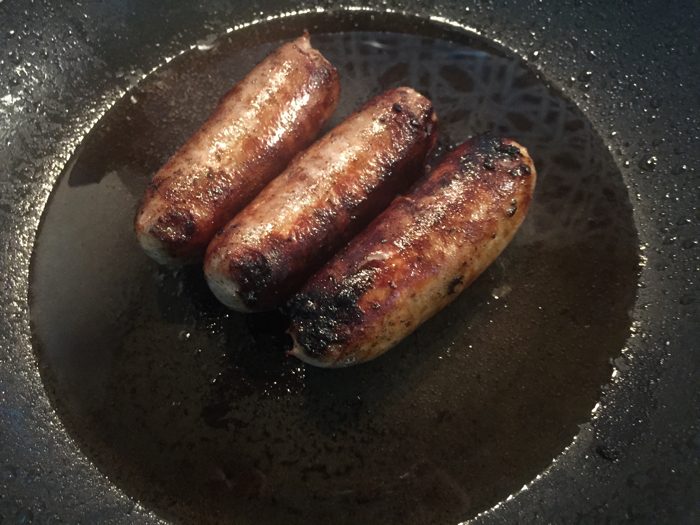
Ask someone to picture the sausages on a full English breakfast and there is a good chance they are picturing a Lincolnshire. It is one of the great regional British sausages, and quite possibly the one we eat most often at breakfast.
Two things make a Lincolnshire a Lincolnshire. The pork is coarsely chopped, so the sausage has an open, chunky texture, and the flavour is sage. That is really all there is to it, and that is the beauty of it. Other regional sausages go in for pepper and spice. The Lincolnshire is herby, savoury and gentle, and people in the county take a dim view of anyone who starts adding parsley or thyme. By tradition they come eight to the pound, in natural skins.
Lincolnshire has always been pig country, and sage runs right through its cooking. If you have ever had stuffed chine or haslet, two other Lincolnshire specialities, you will know they are flavoured with sage too. The sausage is part of the same family.
Nobody really knows how old it is. The earliest written recipe we know of dates from May 1886. There is a butcher's family in Grimsby who say their recipe goes back to 1810. Our guess is that Lincolnshire butchers were making coarse, sagey sausages long before any of them thought to write it down.
This is the sad part of the story. Unlike the Cumberland sausage, the Lincolnshire has no legal protection at all, and it wasn't for want of trying.
In 2004, thirteen Lincolnshire butchers got together and applied for Protected Geographical Indication status, which would have meant that only sausages made in the county, to an agreed recipe, could use the name. The Lincolnshire Sausage Association was set up in 2006 to back them. The recipe they put forward was a sensible one: coarse cut British pork, at least 70 per cent meat, no more than 25 per cent fat, breadcrumb or rusk, sage, salt and pepper, in natural pork casings.
In 2012, the application was turned down. The reasons given were that recipes for Lincolnshire sausages varied too much, even inside the county, and that the sausages had been made outside Lincolnshire for more than twenty years. And there was one killer fact. About 95 per cent of the sausages sold as Lincolnshire were being made somewhere else.
We think that is a great shame. It means anybody, anywhere, can make any sausage they like and call it a Lincolnshire, and a sausage from a proper Lincolnshire butcher may have nothing in common with a supermarket multipack except the word on the label.
Since the law won't help you, you will have to use your eyes. Check the meat content first. It should be at least 70 per cent, and a good butcher's sausage will be higher. Then look at the sausage itself. You want to see distinct pieces of meat and little flecks of green sage, not a smooth pink paste. And read the ingredients. The list should be short and sage should be on it.
The good news is that the county has not given up. Lincoln still holds a competition every year to find the best Lincolnshire sausage, and the butchers there are as proud of their recipes as ever.
The definitive reference book on the traditional English breakfast.
View the HandbookWe think the Lincolnshire may be the perfect breakfast sausage. Sage and bacon and egg were made for each other, and that coarse texture stands up beautifully to the frying pan. When people talk about a pair of bangers on a full English, this is very often what they mean.
Cook them low and slow. Fifteen to twenty minutes over a low to medium heat, turning them often, until they are evenly browned all over. Don't prick them and don't hurry them. A sausage cooked too fast will split, and one that has been pricked loses the fat that keeps it juicy.
And if you can't find a good one where you live, why not make your own? It is easier than you might think, and we have published our own Lincolnshire sausage recipe to get you started.
If you are interested in history, heritage and recipes of the traditional English breakfast, check out our official English Breakfast Handbook, lovingly produced by the English Breakfast Society.
This site is independently run. Reader funding helps keep standards high.