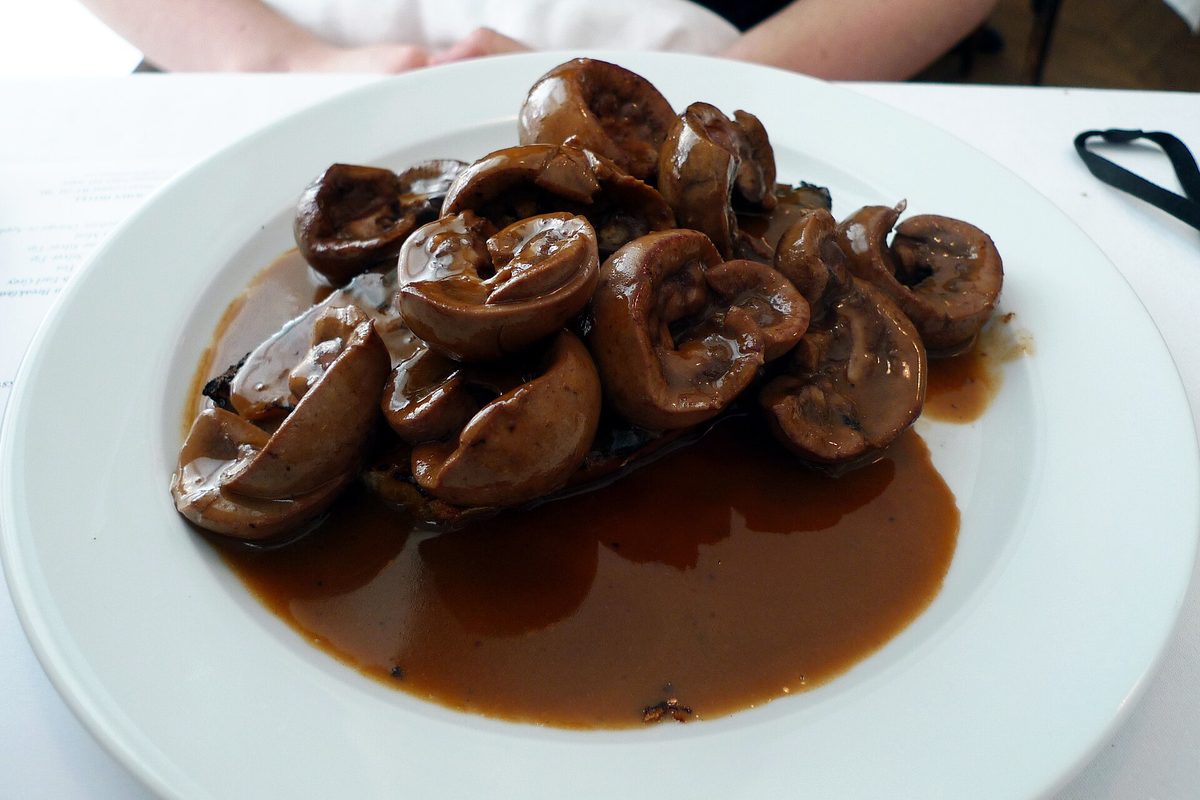
Photo: Ewan Munro, CC BY-SA 2.0, via Wikimedia Commons
Devilled kidneys are not for everybody, and we may as well admit that at the start. But if you are the sort of person who likes their breakfast to wake them up, there is nothing better.
Here is what you get. Lamb's kidneys, cut in half and fried quickly in foaming butter, then coated in a hot, sharp sauce of mustard, Worcestershire sauce and cayenne pepper, and piled on to thick buttered toast. It takes about ten minutes from start to finish, and it is one of the great savoury dishes of the English kitchen.
To devil something simply means to make it fiery, the devil being well known for his fondness for heat. Kidneys were only one of the things that got the treatment. The Victorians devilled bones, chicken legs, eggs, crab and smoked fish with great enthusiasm.
Devilling goes back to the eighteenth century. James Boswell, who wrote the famous life of Samuel Johnson, was very partial to devilled bones, which were the leftovers of a joint smeared with mustard and cayenne and grilled until crisp. It was a way of making a late night supper out of whatever was in the larder, ideally after a long evening.
Two things in the nineteenth century gave us the devil sauce we know today. Ready made English mustard arrived in every kitchen, and in 1837 two chemists in Worcester called Lea and Perrins started selling their Worcestershire sauce. Put those two together with some cayenne and butter and you have it.
Devilled kidneys started turning up in cookery books around the middle of the century, and their real glory days were the Edwardian years. Picture a country house or a gentlemen's club in about 1905, with a long sideboard and a row of covered silver dishes. In one of them is kedgeree, in another kippers, and in a third, keeping hot, the devilled kidneys. That is how people who could afford it started the day, and we can't help feeling slightly envious.
The best known breakfast kidney in any book isn't devilled at all, but we can't leave it out. James Joyce begins the story of Leopold Bloom in Ulysses, on the morning of 16 June 1904, with Bloom going out to buy a pork kidney and frying it in butter for his breakfast. Joyce introduces him as a man who ate with relish the inner organs of beasts and fowls. It is a good reminder of how normal a kidney for breakfast used to be, in Dublin and London alike.
For two people you want six lamb's kidneys, and they really must be fresh, so buy them from a butcher on the day if you can.
If there is a thin skin on the outside, peel it off. Cut each kidney in half lengthways and you will see a white core in the middle. Snip it out with a pair of scissors. This is the only fiddly bit, and it is worth doing properly, because the core is tough.
Mix two tablespoons of plain flour with a teaspoon of English mustard powder, half a teaspoon of cayenne, and some salt and black pepper. Toss the kidneys in it and shake off what doesn't stick.
Heat a generous knob of butter in a frying pan until it foams, and fry the kidneys for about two minutes a side. You want them browned on the outside and still just pink in the middle. Please don't overcook them. An overcooked kidney is rubbery, and it is the reason a lot of people think they don't like kidneys.
Now add a tablespoon of Worcestershire sauce and three or four tablespoons of stock or water. Let it bubble for a minute, shaking the pan, and the flour will thicken it into a glossy sauce that clings to the kidneys. Have a taste. It should be hot, sharp and deeply savoury. Spoon the lot over thick slices of hot buttered toast and eat it straight away.
The definitive reference book on the traditional English breakfast.
View the HandbookDevilled kidneys faded away after the war, along with most offal, and when you do see them now it is usually as a starter or a supper dish. But they have some very distinguished friends. Fergus Henderson, whose London restaurant St John did more than anyone to make offal respectable again, serves them on toast, and has called Caroline Conran's recipe the best ever.
We should say that kidneys are not part of the full English breakfast itself, which has its own defined set of components. They belong to the wider tradition of the British breakfast table. As a breakfast in their own right, though, on toast, with a pot of tea and the newspaper, they take some beating. Be brave. Give them a go.
If you are interested in history, heritage and recipes of the traditional English breakfast, check out our official English Breakfast Handbook, lovingly produced by the English Breakfast Society.
This site is independently run. Reader funding helps keep standards high.

.jpg)