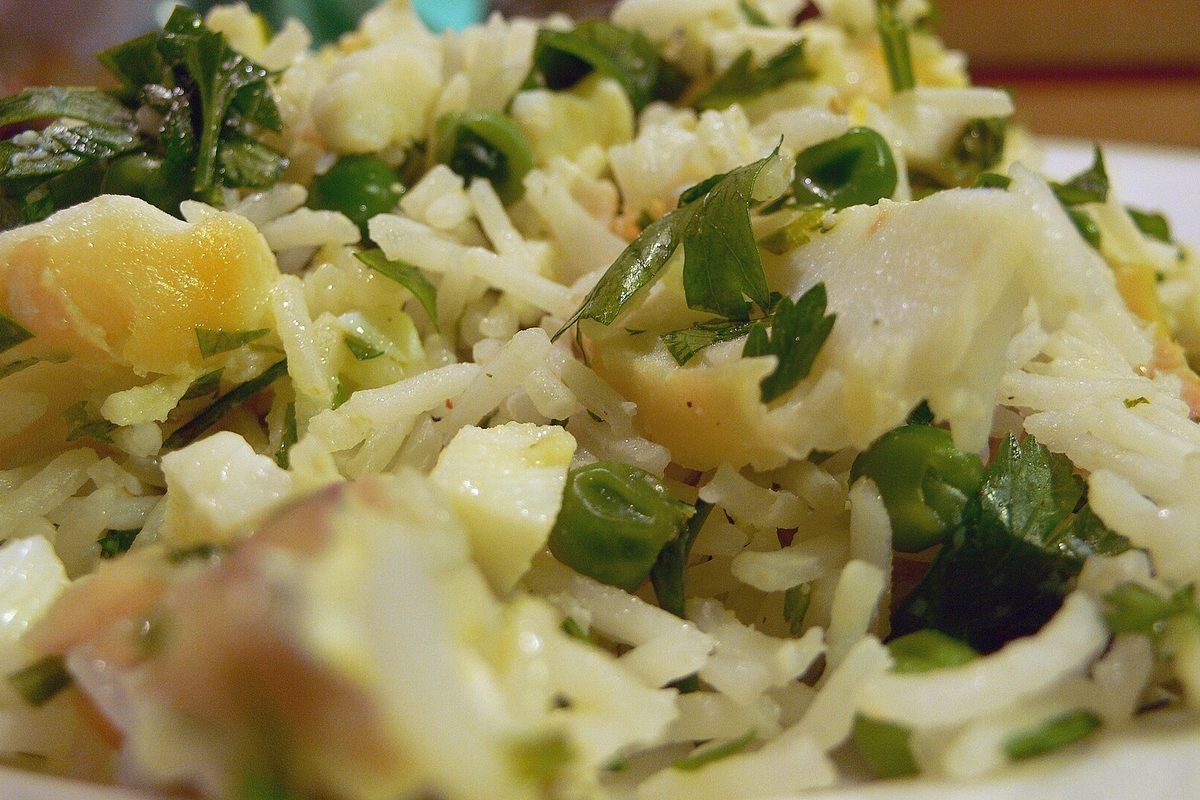
Photo: Justinc, CC BY-SA 2.0, via Wikimedia Commons
Kedgeree is one of our very favourite breakfasts, and if you have never had it, we envy you the first time. It is rice, flakes of smoked haddock, hard boiled eggs, butter and parsley, gently warmed with a little curry spice. It is soft and smoky and comforting, and it is the most elegant thing you can do with a piece of smoked fish.
It is also a completely different kind of breakfast from the fried plate. A full English has to be cooked to order and eaten straight away. Kedgeree is made in one pan and sits quite happily under a lid, keeping warm. That is exactly why the Victorians loved it. In a big country house, breakfast was laid out on the sideboard in covered silver dishes and guests wandered down and helped themselves whenever they got up. Kedgeree was made for that.
The name and the idea both come from India, from a dish called khichri, which is rice and lentils cooked together. People have been eating it across the subcontinent for a very long time indeed. The great traveller Ibn Battuta described a dish of rice and mung beans that he called kishri back in about 1340, and there is a recipe for khichri in the Ain-i-Akbari, the record of the emperor Akbar's court, written around 1590.
Khichri is plain, comforting, everyday food, and the British in India took to it at once. They often ate it at breakfast, with fish and eggs on the side. At some point on the long journey home, the lentils fell out, the fish and eggs went into the rice, and khichri turned into kedgeree.
The earliest British recipe we know of was written down in 1790 by a woman called Stephana Malcolm, of Burnfoot in Dumfriesshire, whose family had a lot to do with India. Because of her, the Scots have a claim on kedgeree, and the theory is that Scottish soldiers and officials coming home from India brought the taste for it back with them.
It got into print in 1845, when Eliza Acton put it in her wonderful Modern Cookery for Private Families under the title Kedgeree or Kidgeree, an Indian Breakfast Dish. Hers is thought to be one of the first recipes to stir egg through the rice, and she cheerfully suggests using cold turbot, brill, salmon, sole or shrimps, whatever you happen to have left over.
By the end of Queen Victoria's reign, kedgeree was on every smart breakfast table in the country, next to the kippers and the devilled kidneys. Smoked haddock, especially the Finnan haddock from the east coast of Scotland, had become the fish to use, and it still is.
This will feed four people. You need about 450 grams of undyed smoked haddock, 300 grams of long grain or basmati rice, four eggs, an onion, 50 grams of butter, two teaspoons of mild curry powder, a good handful of chopped parsley and a lemon.
Poach the haddock in barely simmering water for about eight minutes, until it flakes easily. Lift it out, but keep the water, because it is full of flavour. Flake the fish and throw away the skin and any bones. Meanwhile boil the eggs for eight minutes, cool them under the cold tap, peel them and cut them into quarters.
Chop the onion and soften it in the butter over a low heat. Don't let it brown. Stir in the curry powder and give it a minute, then stir in the rice so every grain gets coated. Pour in the fish water, topped up with fresh water so you have twice as much liquid as rice. Bring it to a simmer, put the lid on, turn the heat right down and leave it for about twelve minutes, until the liquid has gone and the rice is tender.
Now fold the fish and most of the parsley through the rice with a fork, gently, so you don't break the flakes up too much. Add a squeeze of lemon, a bit more butter and a grind of pepper. You probably won't need salt, as the fish has plenty. Put the eggs on top, scatter over the rest of the parsley, and take it to the table.
Put two kedgeree lovers in a room and they will disagree about nearly everything. Some people add cream. Some add sultanas. Some won't use curry powder at all and season it with cayenne and nutmeg, the way a lot of Victorian recipes did. Some stir raw beaten egg through the hot rice instead of using boiled eggs.
We are relaxed about most of that. Only three things really matter. The rice should be dry and fluffy, never wet. The haddock should be the pale, undyed kind, not the bright yellow stuff. And the spice should be a gentle warmth in the background. Kedgeree is not a curry.
The definitive reference book on the traditional English breakfast.
View the HandbookThese days you are more likely to see kedgeree on a brunch or supper menu than a breakfast one, and it is lovely at any time of day. But we would like to see it back where it belongs. If you have people staying, it is the perfect thing to give them. You can make it before anybody else is up, it keeps warm without complaint, and it makes you look like a far better cook than a fry up ever will.
If you are interested in history, heritage and recipes of the traditional English breakfast, check out our official English Breakfast Handbook, lovingly produced by the English Breakfast Society.
This site is independently run. Reader funding helps keep standards high.