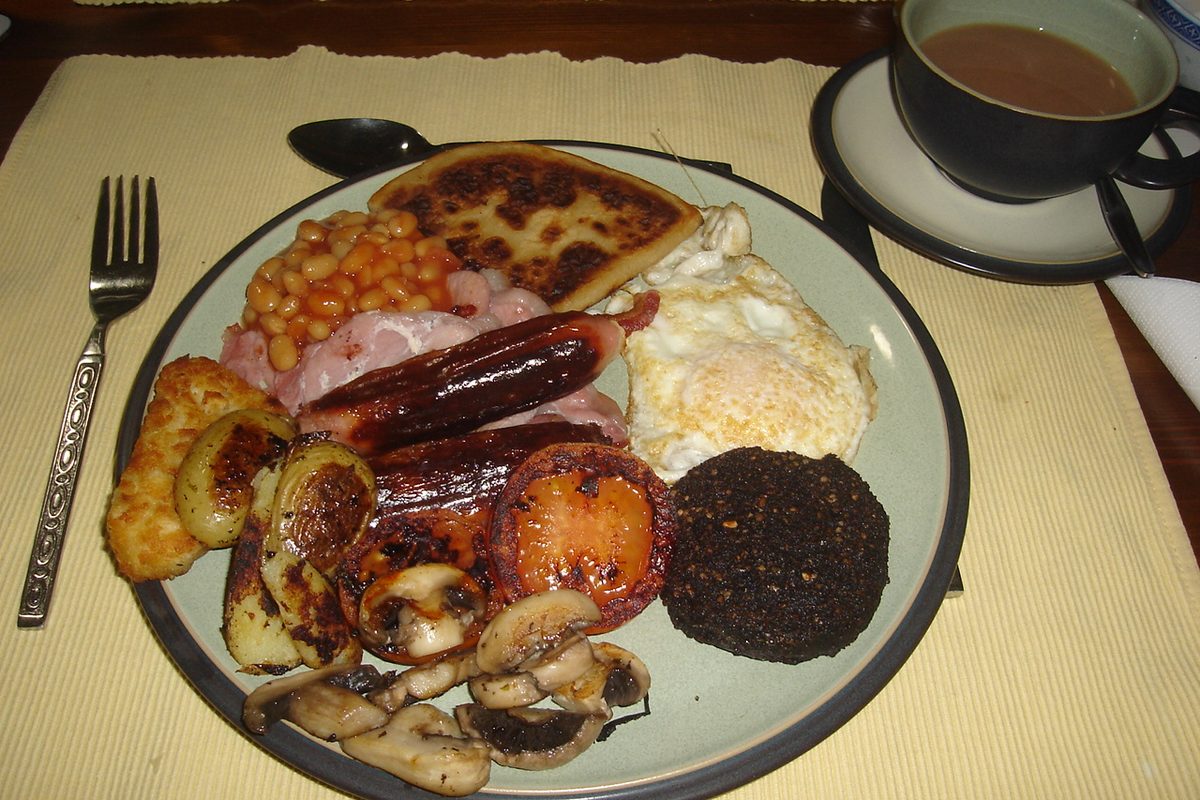
Photo: David Pursehouse, CC BY 2.0, via Wikimedia Commons
We are the English Breakfast Society, so you might expect us to be sniffy about anybody else's breakfast. Not a bit of it. The full Scottish breakfast is a magnificent thing, and we will happily eat one any time we are north of the border.
At first glance it looks a lot like a full English. There is bacon, there are eggs, there is sausage. Then you look closer and notice that the sausage is square, there is a flat potato thing where the fried bread should be, and there may well be a slice of haggis. This is where it gets interesting.
The Scots have been famous for their breakfasts for a very long time. Samuel Johnson was not a man who went around paying Scotland compliments, but after travelling through the Highlands and Hebrides in 1773 even he had to admit it. "If an epicure could remove by a wish, in quest of sensual gratifications," he wrote, "wherever he had supped he would breakfast in Scotland." Coming from him, that is high praise indeed.
There is no official list, and every cafe and hotel does it slightly differently, but a proper full Scottish will usually give you bacon, a fried egg, Lorne sausage or link sausages (or both, if you are lucky), black pudding, a tattie scone, and a grilled tomato or some mushrooms. White pudding, fruit pudding and haggis are all common extras. You will get beans and toast as you would in England, and sometimes oatcakes too.
The bacon is often Ayrshire bacon, a lovely traditional Scottish cure where the back and the streaky are kept together in one piece, rolled, and then sliced.
Nothing says Scottish breakfast like a Lorne sausage. You might know it as square sausage, or sliced sausage, or just slice. It is made from minced beef, or beef and pork, mixed with rusk and spices, and it has no skin at all. The mixture is pressed into a long rectangular tin, turned out like a loaf and cut into slices about a centimetre thick, which then go into the frying pan.
Where the name comes from is a bit of a mystery, and Scots love to argue about it. The story you will hear most often is that it was named after Tommy Lorne, a Glasgow music hall comedian. It is a nice story, but it can't be right. Tommy Lorne was born in 1890, and adverts for Lorne sausage have been found in Scottish newspapers from 1892, including one from Grant's Store in Renton that ran in the Lennox Herald on 18 June that year. He would have been two. The name much more likely comes from Lorne, the district in Argyll.
And the square shape? It is pure genius. A slice of Lorne fits a morning roll exactly, with no gaps and no sausage rolling out of the side. A roll and sausage is the breakfast half of Scotland runs on.
The tattie scone, or potato scone, is the other great Scottish contribution to breakfast. It is a thin, soft flatbread made from mashed potato, butter, salt and just a little flour, about two ounces of flour and half an ounce of butter to a pound of potatoes if you want to make your own. The dough is rolled into a round about six inches across, cut into quarters called farls, and cooked on a griddle, or a girdle as the Scots call it.
At breakfast the farls get fried or warmed through in the pan with the bacon. They are soft, not crisp, and they do exactly the job that fried bread does on an English plate, which is to give you something to mop up your egg yolk with. If you have ever had potato bread on an Ulster fry, it is very much the same idea.
Scottish black pudding is made with a lot of oatmeal, which gives it a rougher, crumblier texture than the English kind. The king of them all is Stornoway black pudding from the Isle of Lewis, made with beef suet, oatmeal, onion and blood. It was given protected status in May 2013, after the islanders got fed up with imitations from the mainland being sold under their name.
White pudding, which the Scots call mealy pudding, is oatmeal, onion and suet with no blood in it. Fruit pudding is a sweeter version with dried fruit, sliced and fried in the same way. And then there is haggis, sliced and fried, which you will find on a lot of hotel breakfasts and which is every bit as good in the morning as it is on Burns Night.
The definitive reference book on the traditional English breakfast.
View the HandbookOur reference guide puts the difference between a full English and a full Scottish breakfast quite simply. A Scottish breakfast typically includes white pudding, and may well include square sausage, tattie scones and sometimes haggis. An English breakfast doesn't include those as standard.
We don't think of one as a version of the other. They are two traditions that grew up side by side from the same Victorian love of a cooked breakfast, each using what its own country did best. A breakfast with a Lorne sausage and a tattie scone on it is a Scottish breakfast, it should be proud to be called one, and if you have never had one, you are in for a treat.
If you are interested in history, heritage and recipes of the traditional English breakfast, check out our official English Breakfast Handbook, lovingly produced by the English Breakfast Society.
This site is independently run. Reader funding helps keep standards high.

.jpg)