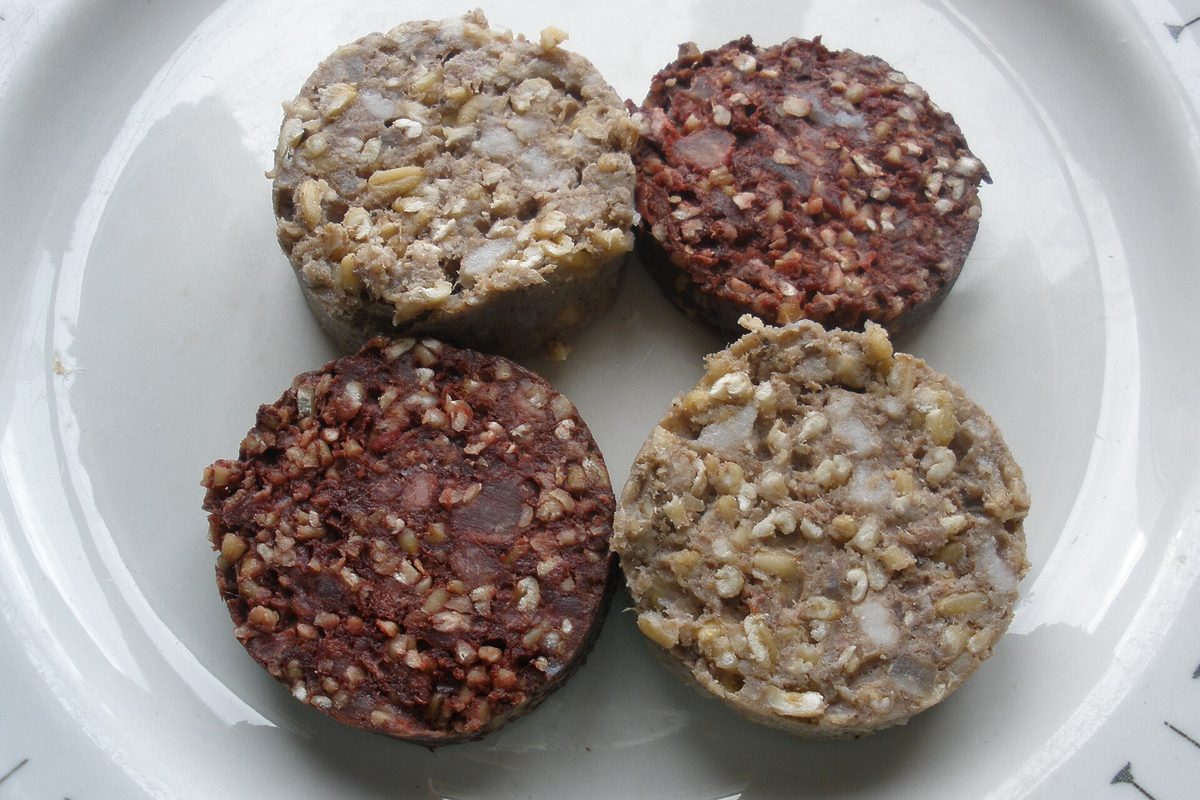
Photo: O'Dea, CC BY-SA 4.0, via Wikimedia Commons
If you have ever sat down to breakfast in Ireland or Scotland and found a pale, speckled slice sitting next to the black pudding, you have met white pudding. And if you ate it, you probably went looking for more, because it is one of the most quietly delicious things you can put on a breakfast plate.
The easiest way to explain it is this: white pudding is black pudding without the blood. Everything else is much the same. You take oatmeal or barley, suet or pork fat, breadcrumbs, a bit of onion and plenty of seasoning, pack it into a skin and cook it. Leave the blood out and you get something completely different in character. Black pudding is dark, rich and a little bit dangerous. White pudding is mild, oaty and peppery, a bit like the best stuffing you have ever had, in sausage form.
This is very good news for anyone who can't bring themselves to eat black pudding. We know plenty of people who won't touch the stuff and will happily clear a plate of white pudding without a second thought.
Here is something that surprises almost everybody. White pudding started life as a rich, sweet, spiced dish for people with money.
A fifteenth century English recipe makes it with pork liver, cream, eggs, breadcrumbs, raisins and dates. A recipe from 1588 uses beef suet, breadcrumbs, egg yolk and currants, with nutmeg, sugar and cinnamon. That is closer to a Christmas pudding than to anything you would fry with your bacon. Hannah Woolley was still filling white puddings into skins in her cookbook The Queen-Like Closet in 1670, and a century later Elizabeth Raffald was making hers with rice, lard, ground almonds and currants.
Somewhere along the way, the fruit and sugar quietly dropped out and the oatmeal took over. What was left was the plain, savoury, thrifty pudding we know today, made by people who kept a pig and were not about to waste any of it. We think they got the better end of the deal.
Nobody takes white pudding more seriously than the Irish. On a full Irish breakfast you get a slice of black and a slice of white, side by side, and a plate with only one of them just looks wrong. In Irish it is called putóg bhán.
Irish white pudding tends to have a good bit of pork in it as well as fat and oatmeal, which makes it softer and more like a sausage. The most famous name in Irish pudding is Clonakilty, down in County Cork, and here is a nice bit of trivia: although Clonakilty black pudding goes back to the nineteenth century, the white pudding only joined it in 1986. It has made up for lost time since.
In Scotland you will hear it called mealy pudding, or mealie pudding, after the oatmeal that makes up most of it. The Scottish version is simpler and leaner: oatmeal, onion and beef suet, salt and pepper, and that is about it. It is crumblier than the Irish kind and wonderfully savoury.
The Scots do some marvellous things with it. It turns up on a full Scottish breakfast, it is eaten with mince and tatties, and, this being Scotland, it is also battered, deep fried and sold in chip shops, where a white pudding supper means a pudding with chips. Fry the same mixture loose in a pan without the skin and you have skirlie, which is glorious next to a roast chicken. There is even a sweeter cousin called fruit pudding, with dried fruit in it, that gets sliced and fried at breakfast too.
We English have our own white puddings, although we have been far too quiet about them. The best known is hog's pudding, which comes from Devon and Cornwall and has a lot more spice in it. Northumberland has an old tradition of white pudding made with barley, and back in the seventeenth century the poet John Taylor was singing the praises of the white puddings of Somerset.
We should be honest here, though. White pudding is not a standard part of the English breakfast. As our reference guide explains, it is one of the things that marks out a Scottish or an Irish breakfast from an English one. That said, if you are in the West Country and somebody offers you a slice of hog's pudding with your bacon and eggs, say yes.
The definitive reference book on the traditional English breakfast.
View the HandbookThe good news is that white pudding comes already cooked, so you really can't go far wrong. All you are doing is warming it through and giving it a lovely crisp crust.
Cut it into slices about a centimetre thick, and peel off the skin if it is a plastic one. Fry the slices in a little bacon fat, lard or oil over a medium heat for three or four minutes a side, until both faces are golden and crisp and the middle is hot and soft.
The one mistake people make is rushing it. Oatmeal burns easily, and a slice that is black on the outside and cold in the middle is a sad thing. Keep the heat moderate, cut your slices on the thick side so they hold together, and turn them once, gently. You can also grill it, or put it in a moderate oven for about ten minutes.
Then put it where it belongs, next to the black pudding, the bacon and a fried egg. It soaks up egg yolk beautifully, and its gentleness is exactly what you want next to all those big, salty flavours. Give it a try. We think you will be converted.
If you are interested in history, heritage and recipes of the traditional English breakfast, check out our official English Breakfast Handbook, lovingly produced by the English Breakfast Society.
This site is independently run. Reader funding helps keep standards high.