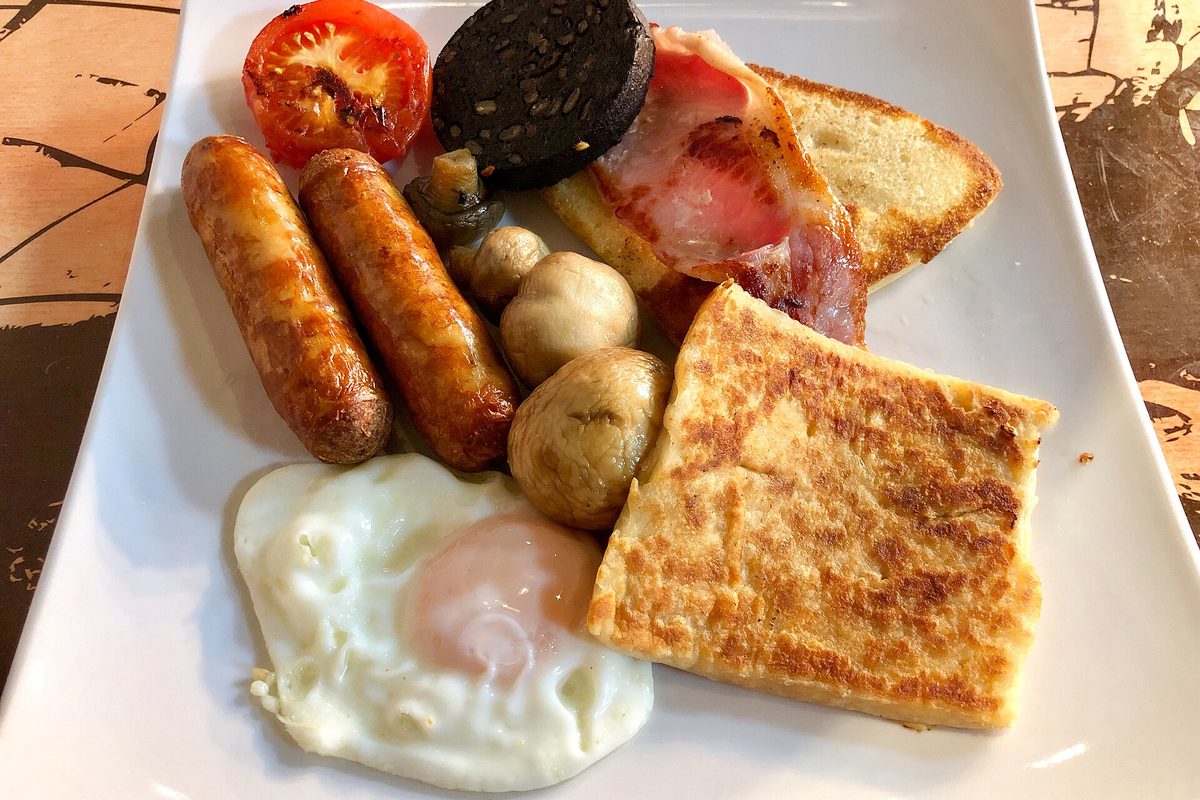
Photo: Kent Wang, CC BY-SA 2.0, via Wikimedia Commons
Ask anyone from Northern Ireland what they miss most when they are away from home and there is a fair chance they will say an Ulster fry. It is the cooked breakfast of the north of Ireland, and people there are fiercely, and rightly, proud of it.
The heart of it is bacon, sausages and fried eggs, just as you would find on a full English or a full Irish. What turns it into an Ulster fry is the bread. A proper fry has soda bread and potato bread, both cut into farls and both fried in the pan until they are crisp and golden.
And don't think of it as only a breakfast. In Northern Ireland a fry is good at any time of day, and cafes will serve you one whenever you ask. When people there have been asked to vote for their favourite dish, the fry has come out on top.
A soda farl is a soft, flat bread made from flour, bicarbonate of soda, salt and buttermilk. The dough is patted into a round, cut into four and cooked on a dry griddle, turned once, so each piece ends up with two floury, browned faces and a soft, tender middle. Farl is an old word for a quarter, which is exactly what each piece is.
Soda breads caught on across Ireland in the nineteenth century, once bicarbonate of soda was cheap enough for every kitchen. For a fry, you split the farl through the middle and fry the two halves, cut side down, in the bacon fat. They go crisp on the outside and stay soft inside, and they taste of bacon. It is hard to think of a better way to treat a piece of bread.
Potato bread, which some people call fadge, is made from mashed potato with a bit of flour, butter and salt, rolled out thin and cooked on the griddle in farls. If you know your Scottish breakfast you will recognise it straight away as a close relative of the tattie scone, and the two traditions are obviously connected.
Fried in bacon fat, potato bread crisps at the edges and stays soft in the middle. It is the thing that most clearly sets an Ulster fry apart from the breakfast you get in the rest of Ireland, and plenty of people will tell you it is the best bit.
People in Ulster take the rules of the fry seriously, and we have a lot of respect for that. To a traditionalist, everything on the plate is fried, and fried in lard or bacon fat for preference. The essentials are bacon, sausages, eggs, soda bread and potato bread. Those five are exactly what the Ulster Fry World Championships ask for, and yes, there really is a world championship, open to all nine counties of Ulster.
Black pudding and white pudding, a fried tomato and a few mushrooms are all perfectly welcome. You will sometimes get a little pancake fried along with everything else, too.
What you will not get, if the cook is a purist, is baked beans or hash browns. Both are considered intruders. We have a lot of sympathy with that, since we feel exactly the same way about hash browns on an English breakfast.
It is worth knowing that Ulster is a province of nine counties. Six of them make up Northern Ireland. The other three, Cavan, Donegal and Monaghan, are in the Republic. The Ulster fry belongs to all nine, and you can get one on either side of the border.
So we don't see the fry as a rival to the full Irish breakfast. It is the northern way of doing it, shaped by the griddle breads that Ulster bakers are so good at.
The definitive reference book on the traditional English breakfast.
View the HandbookUse one big pan and work in order. Start with the sausages over a low heat, because they take longest, and add the bacon once they have begun to colour. When the meat is done, keep it warm and fry the breads in the fat that is left behind. If the pan looks dry, add a bit of lard. Split the soda farls and fry them cut side down first, then fry the potato bread until it is golden on both sides.
The eggs go in last, in the same pan. Put everything on a hot plate, make a pot of strong tea, and sit down to one of the finest breakfasts in these islands.
If you are interested in history, heritage and recipes of the traditional English breakfast, check out our official English Breakfast Handbook, lovingly produced by the English Breakfast Society.
This site is independently run. Reader funding helps keep standards high.