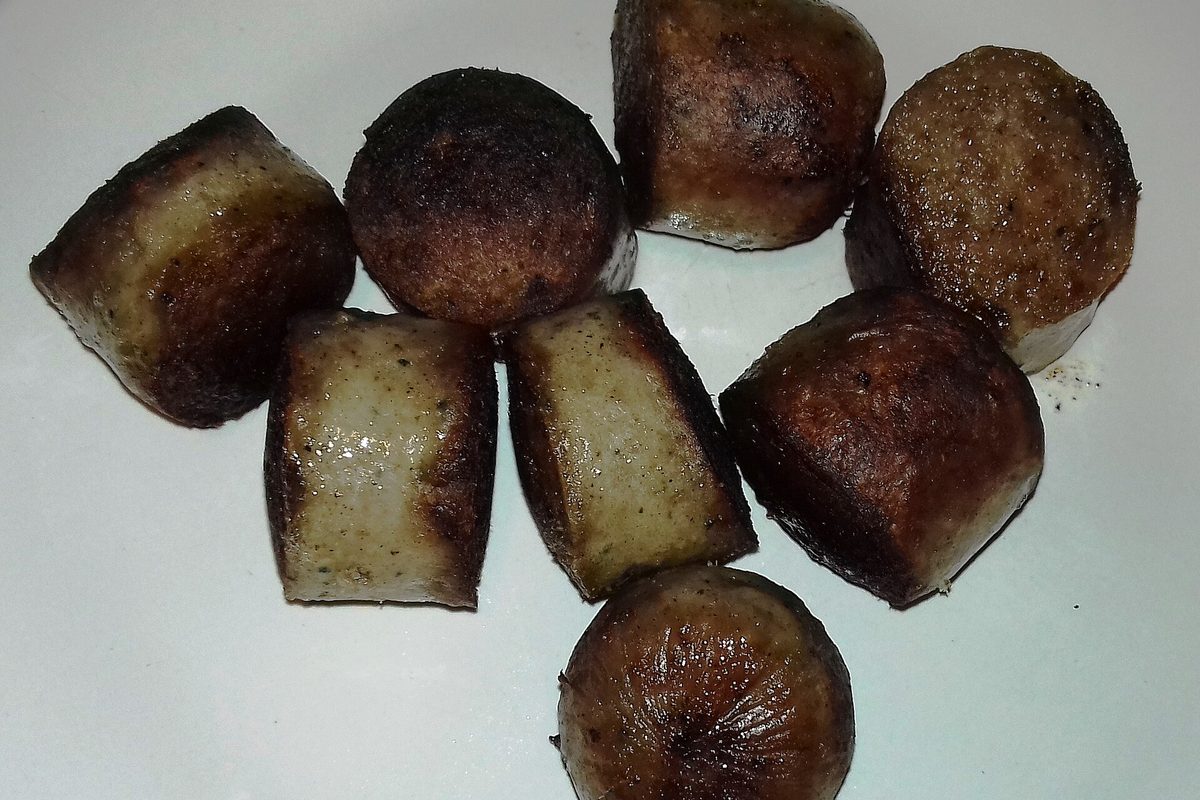
Photo: DuncanHill, CC BY-SA 4.0, via Wikimedia Commons
If you have never been to Devon or Cornwall, there is a good chance you have never heard of hog's pudding. If you have been, and you had a cooked breakfast while you were there, you may well have eaten it without knowing what it was. It was the pale, peppery slice sitting next to your bacon, and it was probably the best thing on the plate.
Hog's pudding is a big, pale, spiced pork sausage, and it belongs to the family of white puddings, which means there is no blood in it. But it is a good deal livelier than the white puddings of Ireland and Scotland. The Cornish have their own word for it, gosogen.
What we love about hog's pudding is how local it has stayed. In the two counties it is completely ordinary. Nearly every butcher makes it and nobody thinks twice about frying it for breakfast. Drive fifty miles east and people look at you blankly. It is one of the least travelled foods in England, and it deserves far better.
The usual recipe is pork meat and pork fat, suet, bread, and either oatmeal or pearl barley. It all gets seasoned, filled into a wide skin to make a fat sausage about two inches across, and boiled. Then it is ready to slice.
The magic is in the seasoning. There is plenty of black pepper, and recipes very often include cumin, basil and garlic as well, which gives hog's pudding a warmth and a fragrance that plain white pudding simply does not have. Every butcher has a recipe and guards it closely, so the pudding you buy in one town can taste quite different from the one you buy in the next. Trying them all is a perfectly good reason for a holiday.
You will find two main styles. The smooth, meaty one is what most people mean by hog's pudding. A coarser one with more whole grain in it is called groats pudding, groats being hulled grain. And some of the older recipes go further still and pack in a lot of offal, liver and lung mostly, which has earned that version the nickname of the West Country haggis.
People in the south west have been proud of their white puddings for a very long time. The poet John Taylor was praising the white puddings of Somerset back in the seventeenth century, and the pudding has been part of West Country life for as long as people there have kept a pig and killed it in the autumn.
Our favourite story about it comes from Devon. In 1843 a servant girl called Mary Willings was caught stealing hog's pudding from her employer at Ipplepen, and was given six weeks in prison with hard labour. It seems terribly harsh to us now. But having eaten hog's pudding, we do at least understand the temptation.
First and foremost, hog's pudding is for breakfast. Cut it into good thick slices and fry them, ideally in the fat the bacon has left behind, until the edges go golden and crusty and the middle is hot. It is already cooked, so a few minutes a side over a moderate heat is all it needs.
On a West Country breakfast it does the job that black pudding does elsewhere in England, and quite often you get both. Up on the north Devon coast, where they gather laver from the rocks, the old tradition is to serve hog's pudding with the cooked seaweed. Across the water, the Welsh do the same thing with bacon and cockles.
It is also very good cold, sliced, straight from the butcher's paper, and it makes a lovely supper fried up with onions and potatoes.
The definitive reference book on the traditional English breakfast.
View the HandbookWe define the English breakfast by its core components, and hog's pudding is not one of them. But it is made in England, by English butchers, to a recipe that goes back centuries, and frankly it has a far better claim to a place on the plate than a lot of the things that turn up there these days.
So here is how we see it. A breakfast in Devon or Cornwall with a slice of hog's pudding on it is an English breakfast with a local accent, and all the better for it. If you find yourself in either county, ask for it. And if you happen to be a butcher somewhere else in England, we would love to see you give it a go.
If you are interested in history, heritage and recipes of the traditional English breakfast, check out our official English Breakfast Handbook, lovingly produced by the English Breakfast Society.
This site is independently run. Reader funding helps keep standards high.