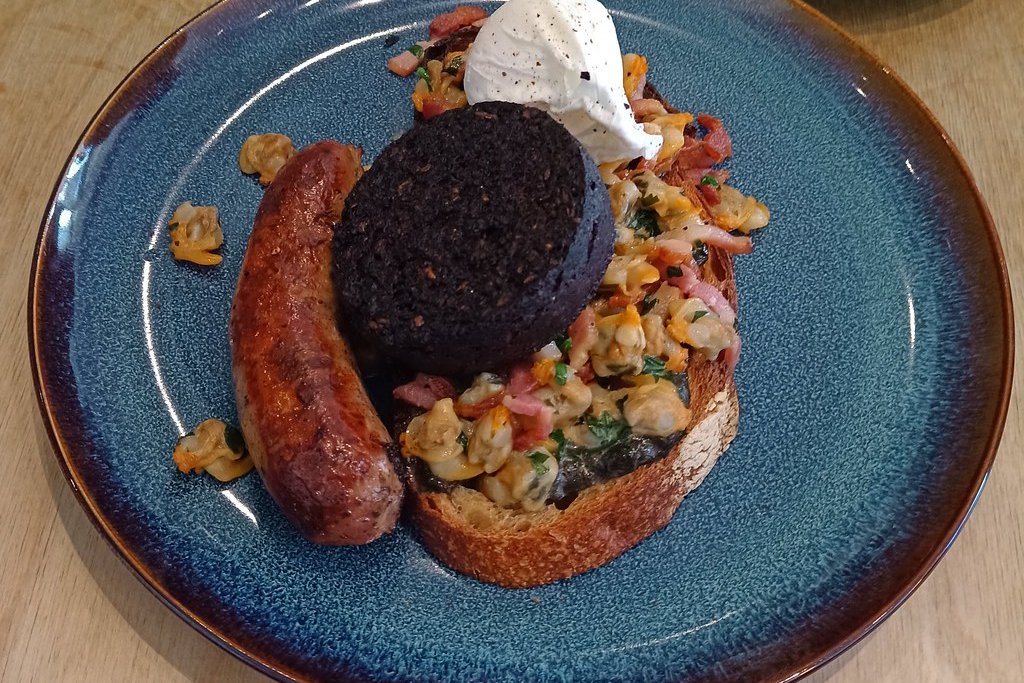
Photo: Haydn Blackey, CC BY-SA 2.0, via Flickr
The Welsh breakfast has something that no other breakfast in Britain can offer, and it comes from the sea. Alongside the bacon, sausages and eggs you would find on a full English, a traditional Welsh breakfast gives you laverbread, which is cooked seaweed, and cockles, both fried in bacon fat.
We know. Seaweed for breakfast sounds like a dare. Stay with us, because it is one of the most delicious and most misunderstood things in British cooking, and once you have had it fried crisp next to a rasher of bacon you will wonder why the rest of us don't eat it.
This is a breakfast of the south Wales coast above all. Laverbread, cockles and bacon was what the miners of the South Wales coalfield ate before a shift underground. It was cheap, it was salty, and it kept a man going.
The first thing to know is that laverbread isn't bread. It is laver, a red seaweed called Porphyra umbilicalis, washed and boiled down to a soft, dark paste. In Welsh it is bara lawr. The plant grows on the rocks all along the western coasts of Britain in thin, silky, almost see-through fronds. If you have ever eaten sushi, you already know a close relation of it, because Japanese nori is made from the same family of seaweed.
Making laverbread takes real patience. The laver is picked off the rocks by hand, rinsed again and again to get rid of the sand, and then boiled for hours until it collapses into a smooth, dark green purée. Nothing goes in but a little salt.
And the taste? Deeply savoury, a bit like olives, a bit like oysters, and not like anything else you have ever had at breakfast. It is also remarkably good for you, full of iodine and iron, which helps to explain why it was so valued by people doing hard physical work.
People have been gathering laver on the Welsh coast for centuries. The first written mention comes from William Camden's Britannia in the early 1600s. By the eighteenth century it was being packed into crocks and sold as potted laver, and it travelled far beyond Wales.
Its most famous fan was the actor Richard Burton, a miner's son from Pontrhydyfen, who is said to have called it the Welshman's caviar. We can't improve on that.
In 2017 Welsh Laverbread was given Protected Designation of Origin status, so anything sold under that name has to be made in Wales from laver gathered on the Welsh coast. Quite right too.
The cockles on a Welsh breakfast traditionally come from Penclawdd, on the north coast of the Gower peninsula. The cockle beds there have been worked for hundreds of years, and for most of that time the work was done by women. They went out on the sands at low tide with rakes and sieves, in all weathers, and carried the catch to Swansea market. It was hard, cold work, and they were famous for it.
For breakfast, the cooked and shelled cockles just need a minute or two in the bacon fat. Any longer and they go tough, so don't wander off.
Fry your bacon first and keep it warm, leaving all that lovely fat in the pan. Mix the laverbread with enough fine oatmeal to make it stiff enough to shape, then form it into small flat cakes about five centimetres across. Fry them in the bacon fat for two or three minutes a side until they are crisp on the outside. These are laver cakes, and they are the best way to meet laverbread for the first time.
Toss the cockles through the pan to warm them, fry your eggs, and put it all on a plate together.
If you would like an even simpler introduction, warm the laverbread as it is and spread it on hot buttered toast with a squeeze of lemon and a grind of black pepper.
The definitive reference book on the traditional English breakfast.
View the HandbookThe Welsh breakfast is the English breakfast's nearest neighbour, and inland you would often struggle to tell them apart. It is on the coast, with laverbread and cockles on the plate, that it becomes something all of its own. Funnily enough, people on the north Devon coast eat laver in much the same way, traditionally with hog's pudding.
Like the Scottish and the Irish, it is a national breakfast in its own right and deserves to be served under its own name. If you are ever in Swansea market, buy some laverbread and some cockles and try it for yourself. You may never look at seaweed the same way again.
If you are interested in history, heritage and recipes of the traditional English breakfast, check out our official English Breakfast Handbook, lovingly produced by the English Breakfast Society.
This site is independently run. Reader funding helps keep standards high.