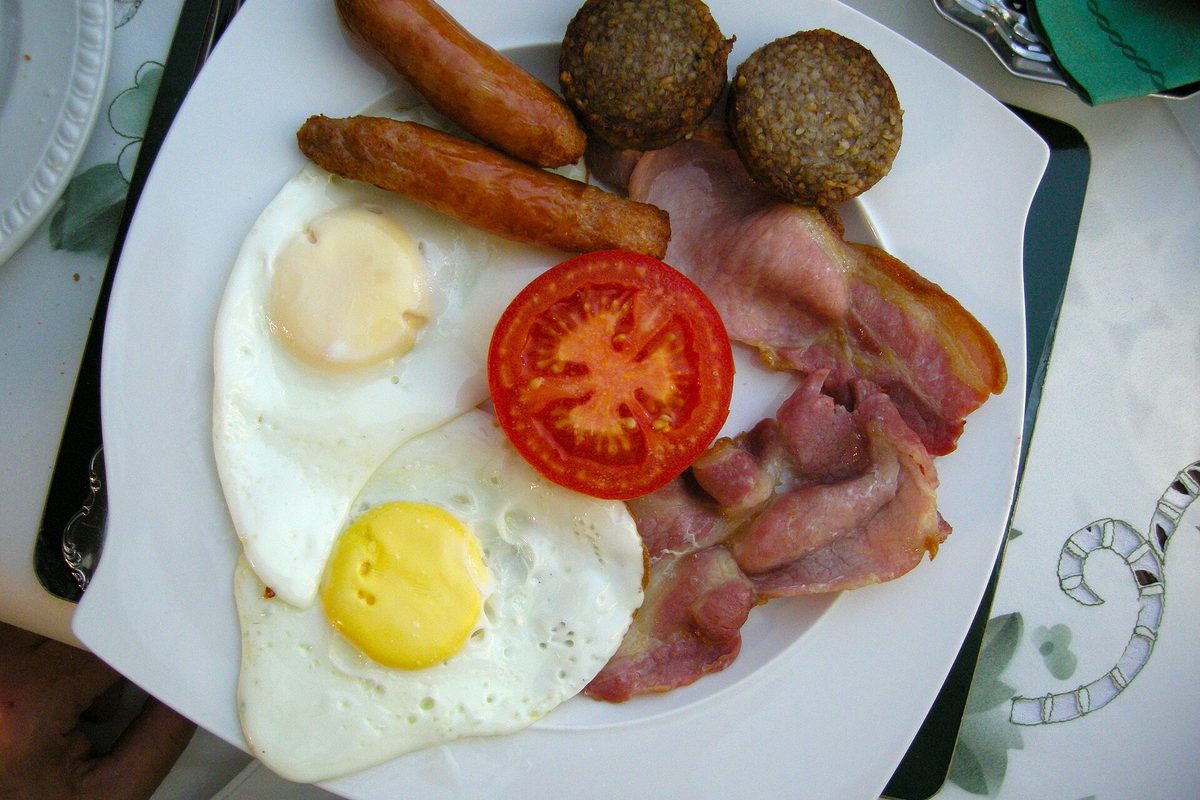
Photo: IrishFireside, CC BY 2.0, via Wikimedia Commons
There are few better ways to start a day than with a full Irish breakfast, and anyone who has had one in a farmhouse kitchen in Cork or Kerry will know exactly what we mean. Rashers, sausages, a slice of black pudding and a slice of white, a couple of fried eggs, a grilled tomato, and soda bread with far too much butter on it. Add a pot of strong tea and you are set until dinner.
It is a very close cousin of our own full English breakfast, and the two have most of their ingredients in common. What makes an Irish breakfast Irish comes down to two things: the puddings and the bread.
It began as a farmhouse meal. For generations Irish country families kept a pig, and the breakfast is really a celebration of that pig. Bacon from the cure, fresh sausages, and puddings made from the blood, the fat and the trimmings, so that not a scrap was wasted. The eggs came from the hens in the yard and the bread came off the griddle that morning.
On an English breakfast, black pudding is welcome. On an Irish one, you expect both black and white, a slice of each, side by side. White pudding is made in much the same way as black, with pork, fat, oatmeal or barley and seasoning, just without the blood.
The most famous Irish pudding of all comes from Clonakilty in County Cork, and it has a lovely story behind it. Back in the nineteenth century a butcher called Philip Harrington had a shop on what is now Pearse Street. A local woman made black puddings at home using his spice mix, and when she retired in the 1880s, Harrington took over making them himself. People loved them so much that they were posted overseas to emigrants who were missing the taste of home.
In 1976 the business was bought by Edward Twomey. He was not all that keen on the pudding at first and thought about dropping it. His customers very quickly put him right. People were travelling across Munster to buy it, and they were not about to let it go. The recipe for the spice mix is still a closely guarded family secret. The white pudding came along in 1986.
A rasher is simply a slice of bacon, and Irish rashers are back bacon, cut from the loin, just like the back bacon on an English breakfast. Neither of us goes in for streaky, and we are both right.
Irish breakfast sausages are pork, finely textured and gently seasoned, usually a bit smaller and more delicate than the big coarse regional British sausages like the Cumberland and the Lincolnshire. They are extremely easy to eat a lot of.
This is where Ireland really shines. Soda bread is raised with bicarbonate of soda and buttermilk instead of yeast. It took off in Ireland in the nineteenth century, when bicarbonate of soda became cheap, and it suited the soft Irish wheat perfectly. At breakfast you get brown soda bread, sliced and buttered, or fried in the pan if you are feeling brave.
Then there is potato bread, made from mashed potato and flour, cooked on a griddle in quarters called farls and fried with the bacon. In some parts of the country you will get boxty, a pancake made with grated raw potato. Head north and these breads take over the plate entirely, and you have an Ulster fry.
We can't write about Irish breakfast without mentioning the breakfast roll, which is modern Ireland's great contribution to the art. Take everything in a full Irish, the sausages, the rashers, the pudding and the egg, and stuff it into a length of baguette. You can buy one hot from the deli counter of nearly every petrol station and corner shop in the country.
It became a symbol of the boom years of the early 2000s. The economist David McWilliams came up with the name Breakfast Roll Man for the builders and tradesmen who ate one in the van on the way to work. Then in 2006 the comedian Pat Shortt released a song called Jumbo Breakfast Roll. It went to number one, stayed there for six weeks and was the best selling single in Ireland that year. Not many breakfasts can say they have had a number one hit.
The definitive reference book on the traditional English breakfast.
View the HandbookOur reference guide sets out the difference between a full English and a full Irish breakfast. Both have bacon, sausages, eggs and black pudding. The Irish breakfast adds white pudding as an essential, and it traditionally comes with soda bread or potato bread where an English breakfast has fried bread or toast.
The two grew up as neighbours and have been borrowing from each other for well over a century. We think of them as two national versions of the same wonderful idea, each true to its own country. If you are ever in Ireland, don't order the continental.
If you are interested in history, heritage and recipes of the traditional English breakfast, check out our official English Breakfast Handbook, lovingly produced by the English Breakfast Society.
This site is independently run. Reader funding helps keep standards high.

.jpg)